
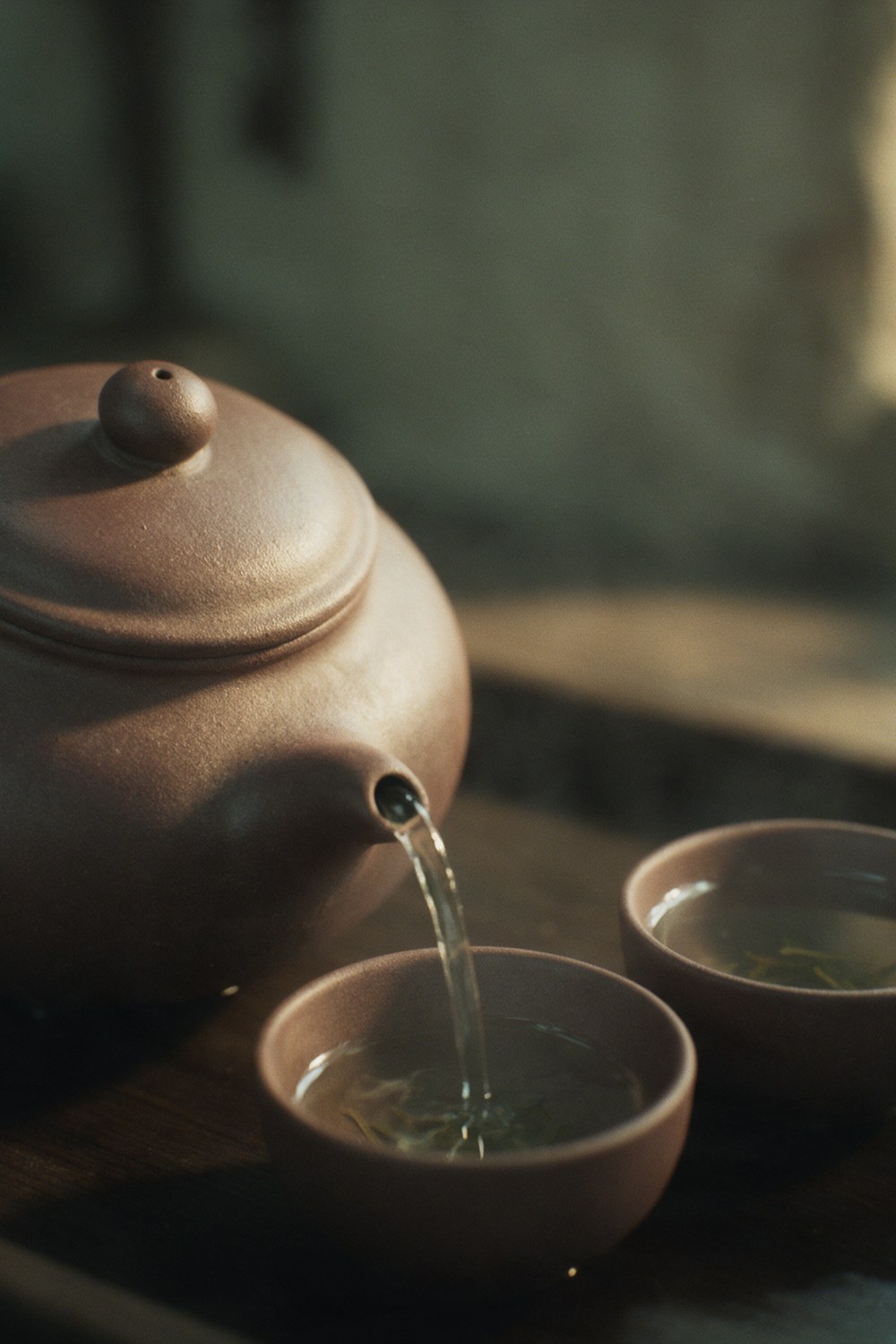
The tea ceremony that most people picture when they hear “Chinese tea ceremony” looks old. Small unglazed pot, small cups, water poured in a tight circle, nobody speaking. It is beautiful, and it is younger than it looks. What is now called 功夫茶 gōngfuchá began as a regional custom around Chaozhou in Guangdong. Through the twentieth century it was taken up by tea people in Taiwan, presented as quintessential Chinese culture, and brought back into mainland China from the 1980s – and on the way it picked up elements of the Japanese tea ceremony, which were then quietly forgotten.
One plant, three ways of drinking it
The long history is real, but it does not run straight. For centuries the leaf was pressed into cakes and boiled; in the Song dynasty it was ground to a fine powder and whisked with hot water in black glazed bowls, which is the ancestor of what the world now knows as matcha. Only later did the Chinese habit settle on loose leaf in a pot. UNESCO, which inscribed China’s tea processing techniques and related social practices on its Representative List in 2022, counts six categories of tea – green, yellow, dark, white, oolong and black – and, with reprocessed teas such as flower-scented ones, more than two thousand products. All of them come from one species.
| Period | How the leaf was drunk | What it needed |
|---|---|---|
| Tang | Pressed into cakes, ground, then boiled | A mill, a sieve, a cauldron |
| Song | Ground to powder and whisked with hot water – 點茶 diǎnchá | Black glazed bowls, a bamboo whisk |
| Ming onward | Loose leaf, steeped in a pot – 散茶 sǎnchá | A pot; from the sixteenth century, unglazed clay |
The Japanese thread
Powdered tea travelled east to Japan, where it became chanoyu and stayed. In China the fashion moved on and the powder was largely forgotten. When twentieth-century tea people set out to build a Chinese ceremony for a modern nation, they borrowed from what had survived – which is why the etiquette, the utensils and the vocabulary of the modern 功夫茶 gōngfuchá carry traces of Japan. The borrowing is not a scandal. It is simply what was left out of the story later.
Why the old story is so appealing
A ceremony that claims a thousand years feels like a root, and roots are useful: to a nation rebuilding an identity, to a teahouse selling an experience, to any of us looking for something unhurried. The appeal is understandable. The accuracy is another matter: what looks like one continuous tradition is a series of choices – Tang cakes, Song powder, Ming leaf, and a modern ceremony assembled in living memory. Teahouses themselves have been a social institution for centuries, important enough that they were politically attacked in early twentieth-century China – not a museum piece but a workplace, a market and a place to hear the news.
Where to go next
If you want the other half of the story – the leaf itself, and how one plant becomes six kinds of tea – that question has its own page, with the sources: how the same leaves make six different teas. The rest of the objects – porcelain, jade, the qin, the lantern – are on the Season One index.
What this means when you drink it
None of it makes the tea taste worse. If anything the opposite: the cup in front of you is not a relic but a living habit that people keep changing. Families in China drink tea in homes, workplaces, restaurants and temples, and serve it at weddings. The ceremony is a recent layer on top of something much older and much more ordinary – an everyday drink that happens to be very good at carrying meaning.
Watch the film
This piece accompanies the film Tea 茶, from Season One: The Art of Chinese Tea.
Questions
Is gongfu tea an ancient tradition?
Not as a national ceremony. Gongfucha began as a regional custom around Chaozhou, in Guangdong. In the twentieth century Taiwanese tea people took it up, presented it as quintessential Chinese culture, and it travelled back into mainland China from the 1980s onward – which is why most people in China had not heard of it a few decades ago.
Did matcha come from China or Japan?
From China. Powdered green tea was drunk in China in the Song dynasty, and knowledge of it travelled to Japan, where it became chanoyu. In China the fashion moved on to loose leaf; in Japan it stayed.
What did tea look like before gongfu tea?
Three forms in three periods. In the Tang dynasty the leaf was pressed into cakes and boiled; in the Song dynasty it was ground to powder and whisked with hot water in black glazed bowls – the ancestor of matcha; from the Ming dynasty onward it was loose leaf, brewed in a pot. One plant, three ways of drinking it.
Is tea still part of a Chinese wedding?
Yes. UNESCO, which inscribed China’s tea techniques and social practices in 2022, lists tea as an important part of ceremonies such as weddings – alongside its everyday role in homes, workplaces, teahouses, restaurants and temples.
Chinese words in this piece
| Chinese | Pinyin | English |
|---|---|---|
| 茶 | chá | tea |
| 功夫茶 | gōngfuchá | gongfu tea, the modern ceremony |
| 點茶 | diǎnchá | whisked tea, the Song way |
| 餅茶 | bǐngchá | cake tea, the Tang way |
| 散茶 | sǎnchá | loose-leaf tea |
| 茶館 | cháguǎn | teahouse |
| 抹茶 | mǒchá | matcha, powdered green tea |
The film, in words
Every caption card that appears on screen in the film, in order. The film has no narration – this is its full text, so it can be read and quoted.
Read the full text – 48 caption cards
- One leaf became a culture.
- Part two: the people, the history, the symbols.
- In the Tang dynasty, tea was pressed into cakes.
- Ground to powder, then boiled with water.
- Cake tea — 餅茶, bǐngchá.
- In the Song dynasty, powder was whisked with hot water.
- The bowls were black, so the white foam showed best.
- A Song poem: partridge-feather bowls, snow in a hare's-fur cup.
- Tea travelled with Chan Buddhism.
- Monks drank it to stay awake through long meditation.
- A master answered every question the same way: "Have some tea."
- Matcha began in China, not Japan.
- Monks carried the powder and the whisk east.
- The same green, a thousand kilometres later.
- Then an imperial order changed everything.
- Pressed cakes were dropped; loose leaf became the norm.
- From then on, tea meant leaf in water.
- Brewing as we know it is a Ming invention.
- Loose leaf wants a pot, and China already had one.
- Unglazed clay from Yixing — 紫砂, zǐshā.
- In a wedding, tea was the promise.
- A tea plant cannot be moved and live — one place, one person.
- To accept a proposal was called "eating tea".
- The teahouse was never only about tea.
- It was an office, a market, and the news desk of its street.
- Along the great river, they multiplied.
- Poets wrote about it for a thousand years.
- Lu Tong: I do not envy the immortals — I envy those who drink tea.
- Cai Xiang set the test: colour, fragrance, taste — all three.
- Around 1600, tea reached Europe.
- First through Portuguese and Dutch traders.
- In 1664 the English East India Company ordered its first 100 pounds.
- The English habit of tea began with one wedding.
- In 1662 Catherine of Braganza arrived to marry — her dowry included tea.
- That same decade, a London diary-writer tasted his first cup.
- For most of the 1700s, tea was taxed at 119%.
- Smuggling brought in three times the legal trade.
- In 1784 the tax fell to 12.5%, and smuggling ended almost overnight.
- Whatever the century, the moment is the same.
- Water, leaf, and a little time.
- In the 1860s, clippers raced the spring crop to London.
- One ship, launched in 1869, carried about 10,000 chests.
- The teabag came much later: American patents, 1880 to 1908.
- In 1960s Britain, 3% of tea came in bags. Today, about 96%.
- The "ancient Chinese tea ceremony" you have seen is recent.
- Gongfu tea is a local custom from one region, national only in recent decades.
- China never had one fixed tea way — it had many, changing by century.
- One leaf. Six families. Two thousand names — and a thousand years of company.
Twelve free pages on the same material are in The Art of Chinese Tea: A First Look.
Sources
- Lawrence Zhang, “A Foreign Infusion: The Forgotten Legacy of Japanese Chadō on Modern Chinese Tea Arts”, Gastronomica 16(1), University of California Press, 2016
- UNESCO Intangible Cultural Heritage – Traditional tea processing techniques and associated social practices in China (No. 01884, inscribed 2022)
- Rebecca Corbett, “Matcha: A Short History from the Song Dynasty to Social Media”, Education About Asia, University of Southern California
- The Metropolitan Museum of Art – “If Tea Bowls Could Talk”, Chinese ceramics
The films and the music are AI-assisted and then chosen, written and cut by hand. Nothing on this page is invented: every claim above is drawn from the sources listed, and anything we could not confirm has been left out.
Written and published by Eastern Whispers — how this site researches, and how it discloses its sources