
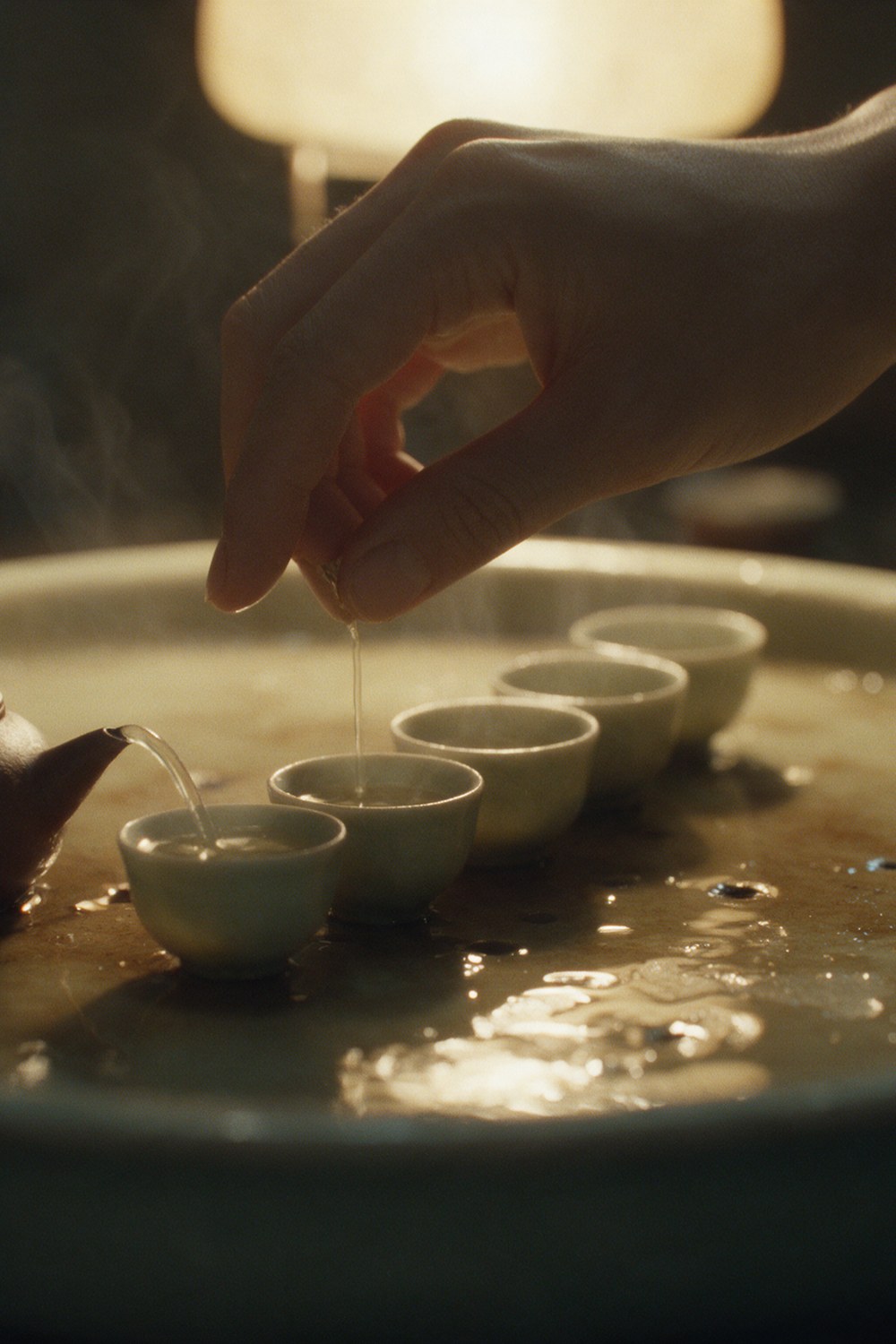
A gaiwan and a Yixing pot do different jobs, and that is the whole answer. The gaiwan is a glazed porcelain bowl that holds no flavour of its own, so it can be used for any tea. The Yixing pot is unglazed clay that takes in what it holds, so most drinkers keep one pot for one family of tea.
Two pots, two jobs
The two vessels look like variations on a theme. They are not. A gaiwan is a lidded bowl, usually porcelain, with no handle and no spout. It comes in three pieces: saucer, bowl and lid. A Yixing pot, 紫砂 zǐshā, is an unglazed clay teapot from Yixing in Jiangsu, made since the sixteenth century. One is a bowl you pour from. The other is a pot that keeps something. The difference is the whole story.
What a gaiwan is for
The gaiwan, 蓋碗 gàiwǎn, appears in the Ming. It is usually porcelain, and it holds roughly 100 to 150 millilitres. Its parts work as tools. The lid is a strainer and a lid at once, so you tilt it to hold the leaf back as you pour. The glaze is open, so you watch the colour of the liquor as it leaves the bowl. Because the porcelain is glazed, it does not take on the flavour of what it holds. A gaiwan can be used for tea after tea, and nothing carries over from the last one.
This is why the gaiwan has a reputation as the honest vessel. It adds nothing and hides nothing. You see the leaf, you see the colour, and you decide when to pour. That makes it a good place to meet a tea you do not know yet, because the bowl is not already committed to a flavour.
What a Yixing pot is for
The pot, 茶壺 cháhú, is small in gongfu service, about 60 to 200 millilitres. Small matters. Little water and a lot of leaf means you can control the pour, and control is the point. A Yixing pot of 紫砂 is unglazed. It is called purple clay, but the fired pots come out red-brown, pale yellow or purple-brown. With no glaze over the clay, the pot takes in the flavour of what it holds. The Victoria and Albert Museum and the Metropolitan Museum of Art both hold examples.
Why one pot is kept for one tea
Here the two vessels part company most sharply. Because the unglazed clay takes in the flavour of what it holds, most drinkers keep one pot for one family of tea. A pot used for oolong smells of oolong, and a pot used for red tea smells of red tea. Put a delicate green tea into a pot that has spent years holding oolong and the pot will not be neutral. The clay is not a fault. It is the feature. A gaiwan, glazed and indifferent, can move across the whole shelf. A Yixing pot is chosen, and then kept.
So the rule is not about status, and it is not about a secret. It is about the clay doing exactly what unglazed clay does. The pot is a small record of every tea it has held.
What the tea does in each vessel
The tea behaves differently in each. In the gaiwan the leaf sits in a bowl you can open and look into. You watch the liquor colour change, you watch the leaves open, and the lid lets you pour without a separate strainer. In the small pot the tea is worked instead: little water, a lot of leaf, and a pour you can stop when you choose. The second pour usually tells you more than the first, and the number of infusions is where a good tea earns its keep.
None of this is only about the pot. All true tea comes from one plant, Camellia sinensis, and the six families, white, green, yellow, oolong, red and dark, are six ways of treating that same leaf. What separates them is what happens after picking, above all how far the leaf is allowed to oxidise before heat stops it. Dark tea is the odd one out: it is not oxidised but fermented, sometimes for months, and is usually pressed into shapes. A green tea and a red tea will ask different things of the water and the timing. The vessel gives you a say in that timing.
Where the pots came from
The gaiwan is a Ming object. The pot is later, and closer to us than it looks. In the Ming, the court moved from pressed tribute tea to loose leaf, a change traditionally dated to 1391. The unglazed Yixing pot with loose-leaf tea appears in the 1500s. Before that the leaf itself was different. The Tang pressed tea into cakes, ground them and boiled them. The Song ground the leaf to powder and whisked it with hot water in a bowl, and competed over the fineness of the foam. That Song method is the ancestor of matcha, which is Chinese and travelled to Japan with monks such as Eisai.
The small pot belongs to the era of loose leaf. It also belongs to a style of brewing that is younger than most people assume. The elaborate small-pot method usually translated as gongfu tea, 功夫茶 gōngfuchá, is a regional custom of Fujian and Guangdong, especially Chaozhou. Three decades ago it was, in the words of one study, “almost unheard of” in most of China. It spread nationally through Taiwan, borrowing from Japanese tea aesthetics as it went. The most traditional thing on the table may be the newest.
Small cups, a tray and a caddy
The pots do not travel alone. Gongfu cups hold about 30 millilitres or less, so the tea is drunk hot and in one mouthful. The liquor is usually poured first into a small jug and then divided, so every cup gets the same. The tea tray carries everything. The Metropolitan Museum of Art holds a hard-paste tea caddy made in China for the American market, dated 1795 to 1800, a reminder that these objects were exports as well as habits.
The mistake to set aside
The common Western picture is of one ancient, unified Chinese tea ceremony, a single rite performed the same way for a thousand years. It is not like that. Chinese tea culture is plural and it keeps moving, from cakes and boiling in the Tang to whisked powder in the Song, then loose leaf and small pots after the Ming. A second misconception lasted for centuries in Europe: that green tea and red tea came from two different plants. The botany was not sorted out until 1905.
It is worth knowing that red tea is named for the colour of the liquid, not the leaf. In Chinese, 紅茶 hóngchá means literally “red tea”. The West calls the same thing black tea because that is the colour of the dry leaf. One object, two names, each true to a different half of the process.
Frequently asked questions
What is a gaiwan used for?
A gaiwan is a lidded porcelain bowl used to steep and pour tea. The lid doubles as a strainer, so you can hold the leaf back as you pour. Because the porcelain is glazed, the bowl does not keep the flavour of the last tea, so you can use one gaiwan for many different teas.
Why do people keep one Yixing pot for one tea?
Yixing clay is unglazed, so the pot takes in the flavour of what it holds. If you brew several kinds of tea in the same pot, the flavours mix and the pot stops being neutral. Most drinkers therefore keep one pot for one family of tea. The pot becomes a record of the teas it has held.
Can I use a gaiwan for any tea?
Yes. The gaiwan is glazed porcelain, so it does not carry flavour from one tea to the next. That makes it a practical vessel for a whole shelf of teas. It also lets you watch the liquor colour and the leaves opening as you pour.
Is a Yixing pot old?
It is older than the gongfu style, but not as old as tea. The unglazed Yixing pot with loose-leaf tea appears in the 1500s, after the Ming court moved from pressed tribute tea to loose leaf. The gaiwan itself appears in the Ming. Both are younger than the leaf, which has been drunk in China for far longer.
Is gongfu tea an ancient tradition?
No, and this is the part that surprises people. Gongfu tea is a regional custom of Fujian and Guangdong, especially Chaozhou. Three decades ago it was almost unheard of in most of China. It spread nationally through Taiwan, borrowing from Japanese tea aesthetics as it went.
Why is black tea called red tea in Chinese?
The Chinese name, 紅茶 hóngchá, describes the colour of the liquid, which is red. The Western name describes the colour of the dry leaf, which is black. Both names are true to a different half of the process. They refer to the same tea, which is fully oxidised before it is heated and dried.
Sources
- UNESCO Intangible Cultural Heritage, Traditional tea processing techniques and associated social practices in China (No. 01884, inscribed 2022)
- Victoria and Albert Museum, Purple Clay: Chinese teapots for scholarly tastes
- The Metropolitan Museum of Art, Teapot (Yixing ware, 19th century), acc. 44.39.1a,b
- The Metropolitan Museum of Art, Tea caddy (made in China for the American market, 1795 to 1800), acc. 51.86.402
- The Metropolitan Museum of Art, If Tea Bowls Could Talk
- Lawrence Zhang, “A Foreign Infusion”, Gastronomica, University of California Press
- Qin Shao, “Tempest over Teapots”, Journal of Asian Studies, 1998
- Encyclopaedia Britannica, Tea; East India Company
- Education About Asia, Matcha: A Short History
Written and published by Eastern Whispers – how this site researches, and how it discloses its sources