
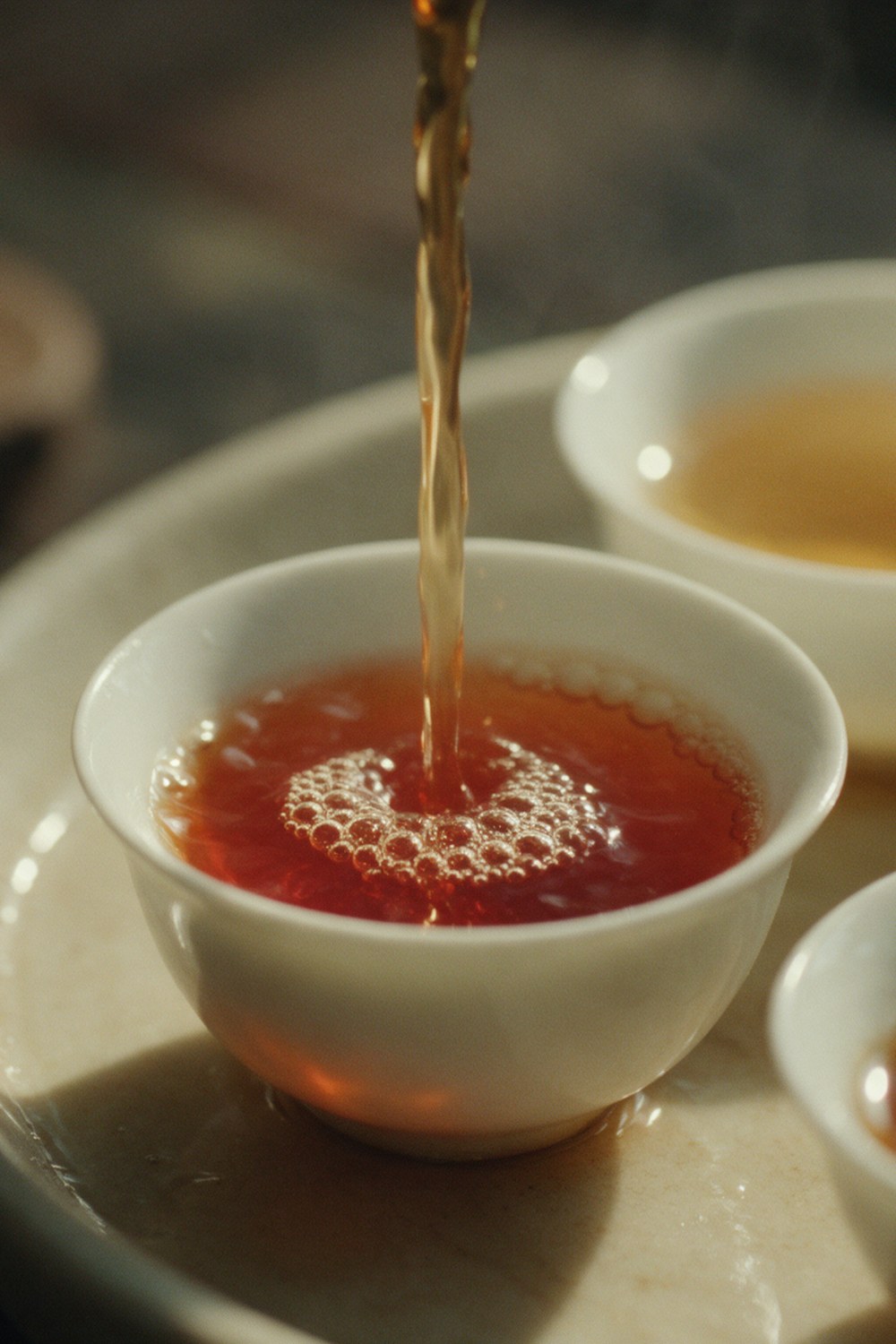
A tea bowl is right when it fits the leaf inside it and the moment it is poured. Chinese bowls are small, handle-less and specific: three pieces, an open glaze, a lid that holds the leaves back. None of that is decoration. Each part is doing a job.
The bowl is doing three jobs
Every part of a Chinese tea bowl answers a problem. It has to hold the tea, keep it warm enough to drink, and let the drinker see what has been made. The gaiwan, 蓋碗 gàiwǎn, is the clearest case. It is a lidded bowl with no handle, in three pieces: saucer, bowl and lid. It appears in the Ming, it is usually porcelain, and it holds roughly 100 to 150 millilitres.
The lid works as a lid and a strainer at the same time, holding the leaves back as you pour. The glaze is left open, so the surface does not hide the liquor. You watch its colour as the tea leaves the bowl, and the glaze does not alter the taste on the way past.
Why the bowl came before the ceremony
In China the bowl is older than the ritual around it. In the eleventh and twelfth centuries the number of tea bowls made in China rises sharply, and the usual explanation is Buddhist meditation: monks drank tea to stay awake. The Jian kilns of Fujian produced almost nothing but tea bowls for a period, an entire industry pointed at one object.
A Chan master is said to have ordered monks to drink tea to keep their minds clear around 713. The Zen master Zhaozhou answered every question with 喫茶去, “go drink tea”, a phrase still hanging on teahouse walls. The bowl was not an accessory to that habit. For a long stretch it was the whole object.
A bowl for foam, then a bowl for leaf
For much of the bowl’s history the drink inside it was not loose leaf. The Tang drank tea pressed into cakes, ground and boiled. The Song whisked powdered tea with hot water in a bowl and competed over the fineness of the foam. Matcha is that Song method, and it is Chinese: it travelled to Japan with monks such as Eisai.
In the Ming the court moved from pressed tribute tea to loose leaf, a change traditionally dated to 1391, and the gaiwan appears in the same dynasty. The bowl’s task changed with the leaf. First it was there to raise and hold a foam. Then it was there to hold leaf and pour.
Two surfaces, two opposite ideas
A bowl and a pot can point in opposite directions. Porcelain goes one way: hard, smooth, glazed and neutral, so the taste that reaches you is the tea’s own. Yixing purple clay, 紫砂 zǐshā, goes the other way. It comes from Yixing in Jiangsu, it has been made since the sixteenth century, and it is left unglazed.
The name says purple clay, but the fired pots come out red-brown, pale yellow or purple-brown. Because nothing seals the surface, the clay takes in the flavour of what it holds, which is why most drinkers keep one pot for one family of tea. The Victoria and Albert Museum and the Metropolitan Museum of Art both hold examples.
Small, because small is controllable
Chinese brewing is largely a matter of small volumes. The gaiwan holds roughly 100 to 150 millilitres. A pot in gongfu service is measured in the same range, about 60 to 200 millilitres, because little water and a lot of leaf means you can control the pour.
Cups hold about 30 millilitres or less, so the tea is drunk hot and in one mouthful. The liquor is usually poured first into a small jug and then divided, so that every cup in the round is even. Gongfu brewing also uses water close to boiling, which is another reason the material of the bowl matters. Porcelain takes heat; unglazed clay keeps it.
The leaf asks for a shape, and the bowl answers
Long before it reaches the bowl, the leaf has already been given a shape. Rolling twists the leaf into strips, presses it flat, or curls it, and that shape is a signature of the maker. Longjing is pressed flat like a sword blade. Biluochun is curled like a snail. Oolong keeps a long, twisted form.
White tea is judged on the fine white down on its buds, and its liquor is pale gold. The colour in the cup is a second signature: gold for an Anxi Tieguanyin, nearer red-brown for a traditional roasted style, and a leaf that runs dark brown to black for red tea. Dark tea is sculptural before it is ever brewed, pressed into cakes, bricks or bowl-shaped nests.
A gaiwan suits green, white and oolong, precisely because it stays out of the way. You are watching the leaf and the liquor, not the vessel.
The shape is a record, not a rule
There is no single Chinese tea ceremony, and no single correct bowl. The Tang drank cakes, the Song whisked powder, and after the Ming came loose leaf and small pots. The elaborate small-pot brewing usually translated as gongfu tea is a regional custom of Fujian and Guangdong, especially Chaozhou.
Three decades ago it was, in the words of one study, “almost unheard of” in most of China. It spread nationally through Taiwan, borrowing from Japanese tea aesthetics as it went. What looks most traditional on a table is often the most modern layer. The same caution applies to the leaf itself: Europeans held for centuries that green tea and red tea came from two different plants, and the botany was not sorted out until 1905.
How to judge a bowl in your hand
Four questions settle most of it. Is the bowl glazed? If it is not, it is keeping something from last time. How much does it hold? The volume decides how much leaf and water you are working with. Does the lid hold the leaves, or does the tea come out cloudy? And does the bowl take heat quickly or hold it for longer?
Then there are the things no bowl can decide for you. Which family of tea is in your cup. Whether the leaves have opened rather than crumbled. How the second pour differs from the first. And the smell of the empty cup, which is the step most people skip.
This article accompanies a film from Eastern Whispers. The film has no narration. It is carried by image and music, and its words arrive as on-screen caption cards. Nothing in it is invented: every claim is drawn from the documented sources listed at the end of this page, and anything those sources could not settle has been left out.
Frequently asked questions
Why does a Chinese tea bowl have no handle?
The gaiwan is a bowl with a lid and no handle, held by the saucer or the rim rather than a grip. It is made in three pieces: saucer, bowl and lid. The design assumes small volumes and a quick pour, not a long carry across a room.
What exactly is a gaiwan?
It is a lidded tea bowl in three pieces, usually porcelain, holding roughly 100 to 150 millilitres. Its lid doubles as a strainer, holding the leaves back as you pour. Its open glaze lets you watch the colour of the liquor without altering the taste, and it suits green, white and oolong teas.
Why are Chinese tea cups so small?
A gongfu cup holds about 30 millilitres or less. Small cups mean each pour is drunk while it is still hot and in a single mouthful. In practice the liquor is poured first into a small jug and then divided between the cups, so the round is even.
Does the material of the bowl change how the tea tastes?
It can. A glazed porcelain bowl stays neutral, so what you taste is the tea. Unglazed Yixing clay takes in the flavour of what it holds, which is why most drinkers keep one pot for one family of tea. Porcelain also takes heat, while unglazed clay keeps it.
Is a tea bowl the same thing as a teapot?
No. The gaiwan is a bowl with a lid; the teapot is a separate vessel, small in gongfu service at about 60 to 200 millilitres. The Ming brought the move to loose leaf and the gaiwan, and the 1500s brought the unglazed Yixing pot. A bowl is the choice when you want to watch the leaf and pour quickly.
Which bowl is right for which tea?
A glazed gaiwan is the general answer, because it stays out of the way, and it suits green, white and oolong. Unglazed clay is for drinkers who want a vessel to hold flavour and who keep it to one family of tea. One thing the sources do not settle is water temperature: the Chinese sources behind this work give no figures, so heat is better treated as a habit you adjust than a number you trust.
Sources
- UNESCO Intangible Cultural Heritage, Traditional tea processing techniques and associated social practices in China (No. 01884, inscribed 2022)
- Victoria and Albert Museum, Purple Clay: Chinese teapots for scholarly tastes
- The Metropolitan Museum of Art, Teapot (Yixing ware, 19th century), acc. 44.39.1a,b
- The Metropolitan Museum of Art, Tea caddy (made in China for the American market, 1795-1800), acc. 51.86.402
- The Metropolitan Museum of Art, If Tea Bowls Could Talk
- Smithsonian Magazine, World’s Oldest Tea; The Guardian, oldest tea remains report
- National Park Service (US), Boston Tea Party Timeline; Boston Tea Party Ships & Museum, Types of Teas Destroyed
- Royal Museums Greenwich, Cutty Sark and the tea trade
- UK Tea & Infusions Association, The History of Tea; Catherine of Braganza
- History News Network, Richard Twining, the Commutation Act, and Smuggling
- Smithsonian Magazine, Who Invented the Tea Bag?; Guinness World Records, first teabags
- Encyclopaedia Britannica, Tea; East India Company
- Lawrence Zhang, “A Foreign Infusion”, Gastronomica (University of California Press)
- Qin Shao, “Tempest over Teapots”, Journal of Asian Studies, 1998
- UCLA Fowler Museum, Steeped in History: The Art of Tea
- National Palace Museum (Taiwan) tea culture exhibition; Hong Kong Museum of Tea Ware
- Chajing 茶經 (Lu Yu) – ChinaKnowledge reference
- Education About Asia, Matcha: A Short History
Written and published by Eastern Whispers – how this site researches, and how it discloses its sources