
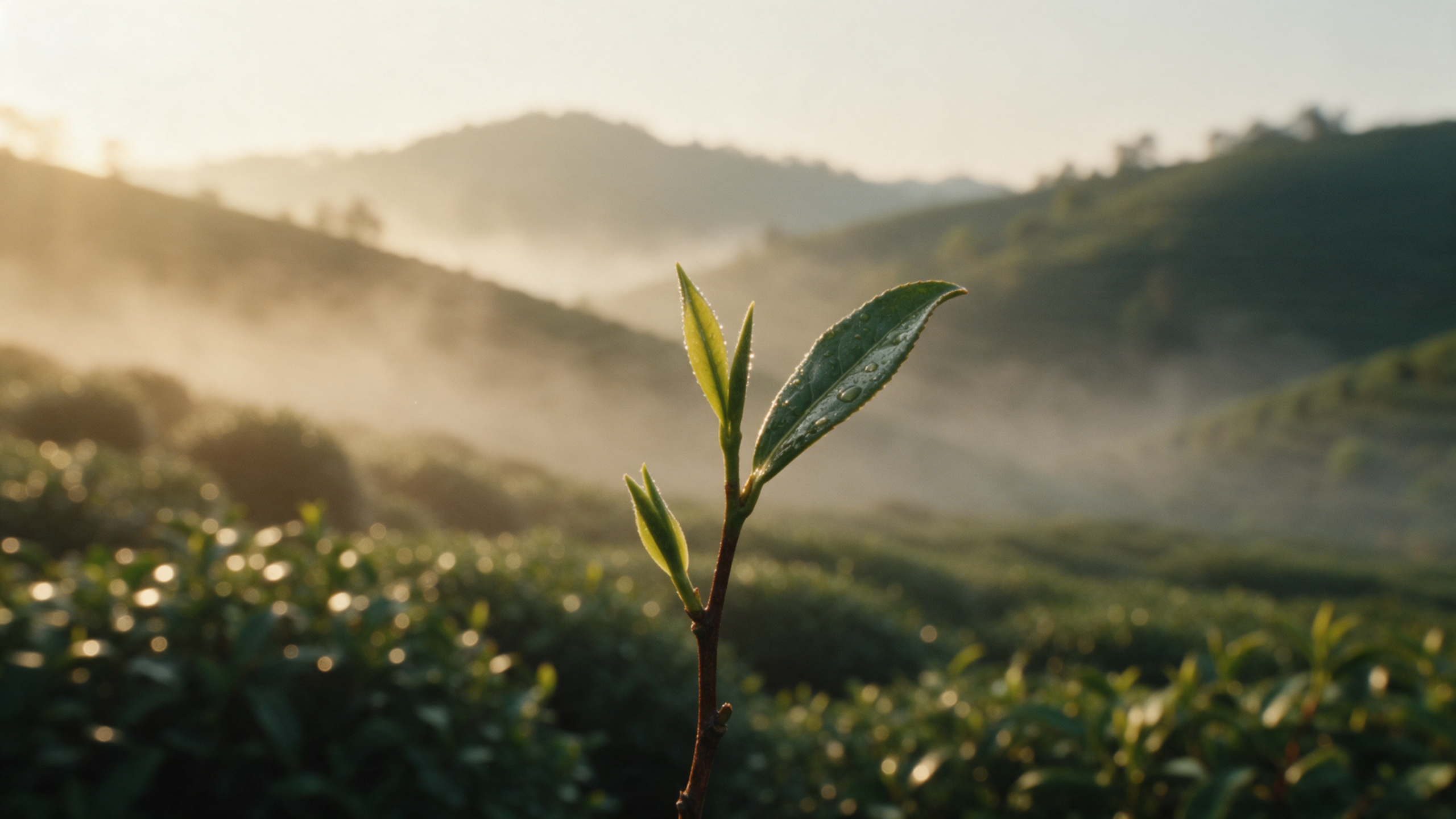
Dragon Well is the taste of a few days in early spring, pressed flat by hand. Every year the hills above West Lake wait for a window that may last less than a fortnight, and a whole harvest is decided inside it.
The tea is 龍井 lóngjǐng, “Dragon Well” — green tea at its earliest: leaves shaped like little sword blades, a liquor the colour of pale jade, and a flavour somewhere between roasted chestnut and cut grass. Some of that is romance. Most of it is chemistry.
What Dragon Well is
Dragon Well, 龍井 lóngjǐng, is a pan-roasted green tea from Hangzhou in Zhejiang province. It is one of China’s best-known teas, and one of the most imitated. The leaf is picked, withered for half a day on bamboo trays, then heated in an iron wok to stop it oxidising — the step that keeps a green tea green, and the reason the same leaf can become six very different teas. The heat is applied by hand, and it is the hand that flattens the leaf into its signature shape.
The name comes from a well beside Longjing village. The old story is that the well holds a dragon: after rain, the lighter rainwater floating on the denser well water is said to form a twisting line that moves like a dragon’s body. The tea took the well’s name.
Watch the film
Episode 3 · Dragon Well Green Tea: The Taste of Early Spring. Premiere date to be announced.
West Lake and the five districts
“Longjing” is a protected name, not just a style. Since 2001 China has protected it as a geographical-indication product under the national standard GB/T 18650. The protected area is large: three production zones, West Lake (西湖), Qiantang (錢塘) and Yuezhou (越州), across eighteen counties in four cities. Only the smallest of them may be called West Lake Longjing, 西湖龍井.
That West Lake zone is the one people mean. It is only a few per cent of the total Longjing area, and inside it sit the five historic districts remembered in the phrase 狮龍雲虎梅 — Lion Peak, Dragon, Cloud, Tiger and Plum Flower. Lion Peak (獅峰) is usually ranked first, for a fragrance described as sharp and long. Meijiawu (梅家塢), the Plum Flower district, is the largest village and the one most visitors actually see. A government designation marks out the protected West Lake region, and only leaf grown inside it earns the name.
Everything outside can still be Longjing-style, and much of it is. Leaf grown in Yunnan, Guizhou or Sichuan and fired the same way is sold as Longjing; honest sellers label it, or add a traceability sticker. The origin on the tin is the first thing to read. Tea was traded long before any of this: it was drunk at caravan inns along the Silk Road, and shipped west in tins by sea.
Mingqian and Yuqian: the calendar in the leaf
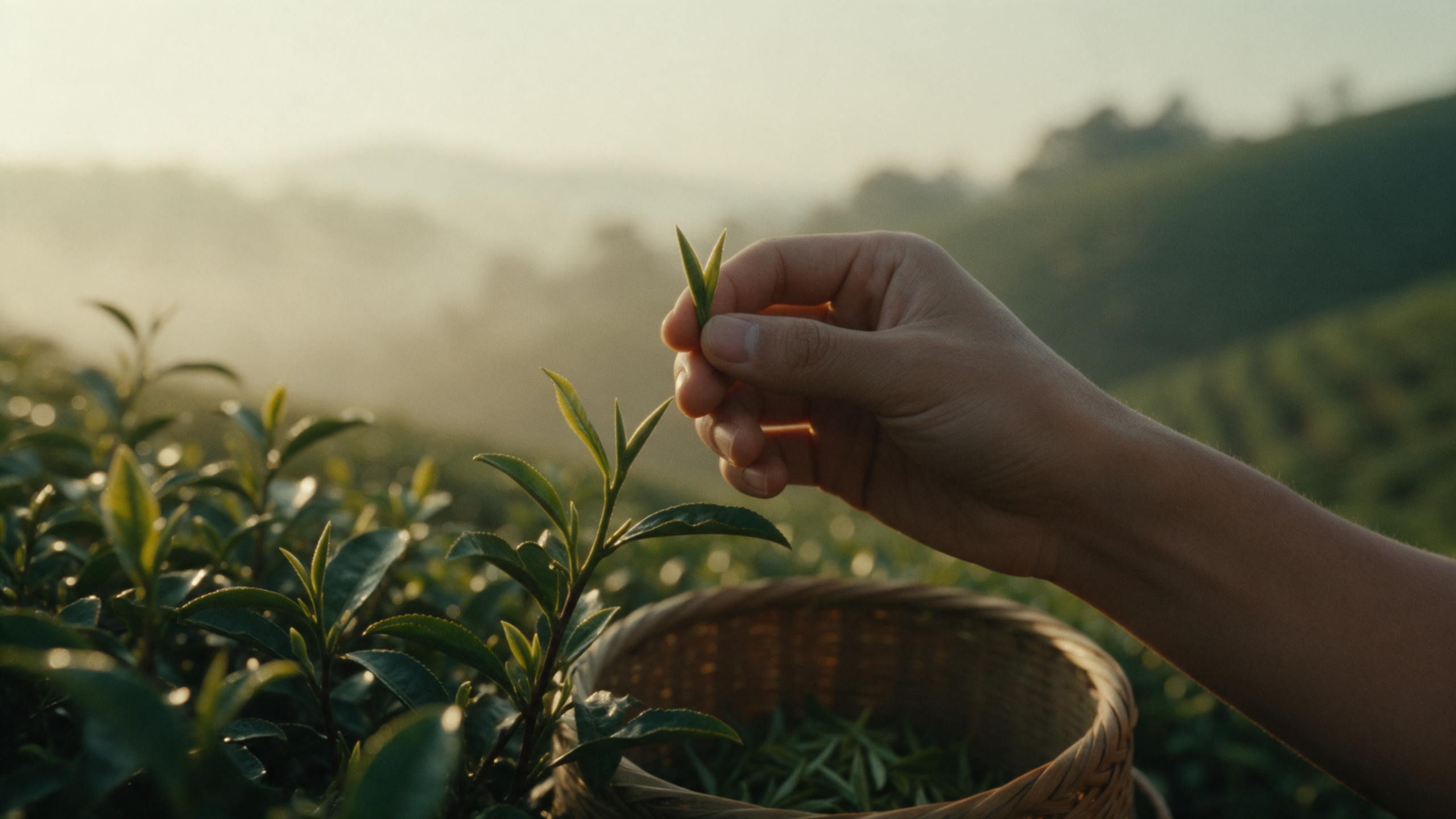
The most valuable Longjing is picked before the Qingming Festival, around 5 April. This is 明前 míngqián, “before Qingming”, the first flush of the year. The second window, 雨前 yǔqián, runs on to Grain Rain (谷雨 Gǔyǔ) in mid-April. Both are spring; the difference is days, and the price gap between them is wide.
Picking itself has three rules — 早、嫩、勤, early, tender, frequent. A local proverb puts it bluntly: three days early is early, the exact three days are treasure, three days late is grass. The best window is roughly ten to twenty days before Qingming, while the air is still between 10 and 20 °C. Cool weather slows the buds, and slow growth leaves more amino acids and fewer bitter polyphenols in the leaf. That is the real reason early is better: not romance, chemistry. Once the spring rains come and the shoots swell, the same bush turns astringent.
Pan-firing by hand
The firing is where Dragon Well is made, and it is done without gloves in a wok heated above 200 °C. The national standard names ten traditional hand movements — 抓、抖、搭、榻、捺、推、扣、甩、磨、壓 — grasp, shake, lay, spread, press with the fingers, push, hook, flick, rub and press flat. The maker moves between them by feel as the leaf changes, a habit summed up as “look at the tea, make the tea”.
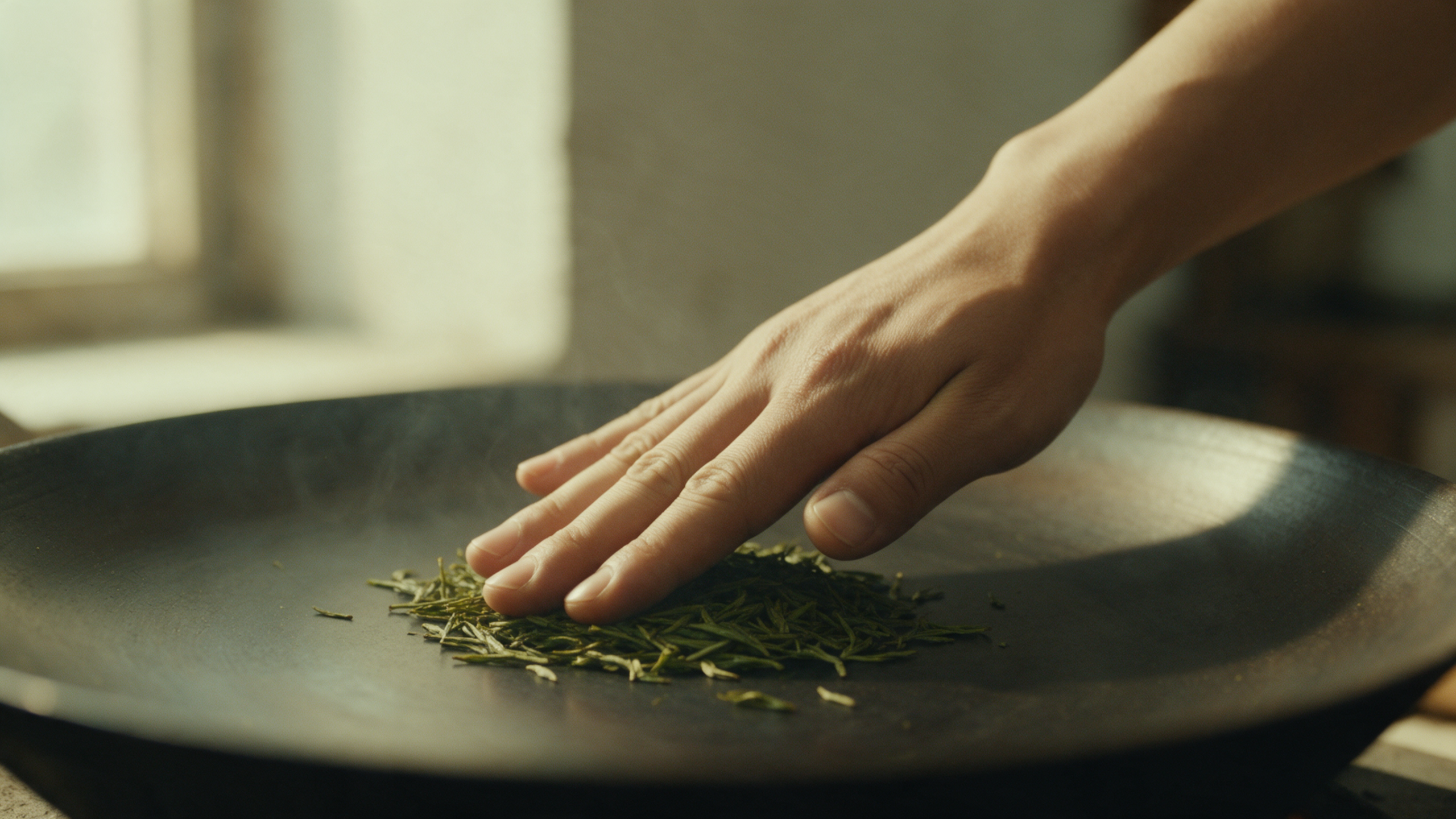
There are two firings. The first, 青鍋 qīngguō, kills the green and begins the shaping; the second, 輝鍋 huīguō, comes at a lower heat and does the long work of flattening and drying. Pressing the leaf against the hot metal is what gives it the flat blade shape that no rolling machine reproduces exactly. It is slow work: an experienced maker can finish about a kilogram of tea in seven to eight hours, and a picker brings in only a couple of kilograms of fresh leaf in a ten-hour day.
How to brew it
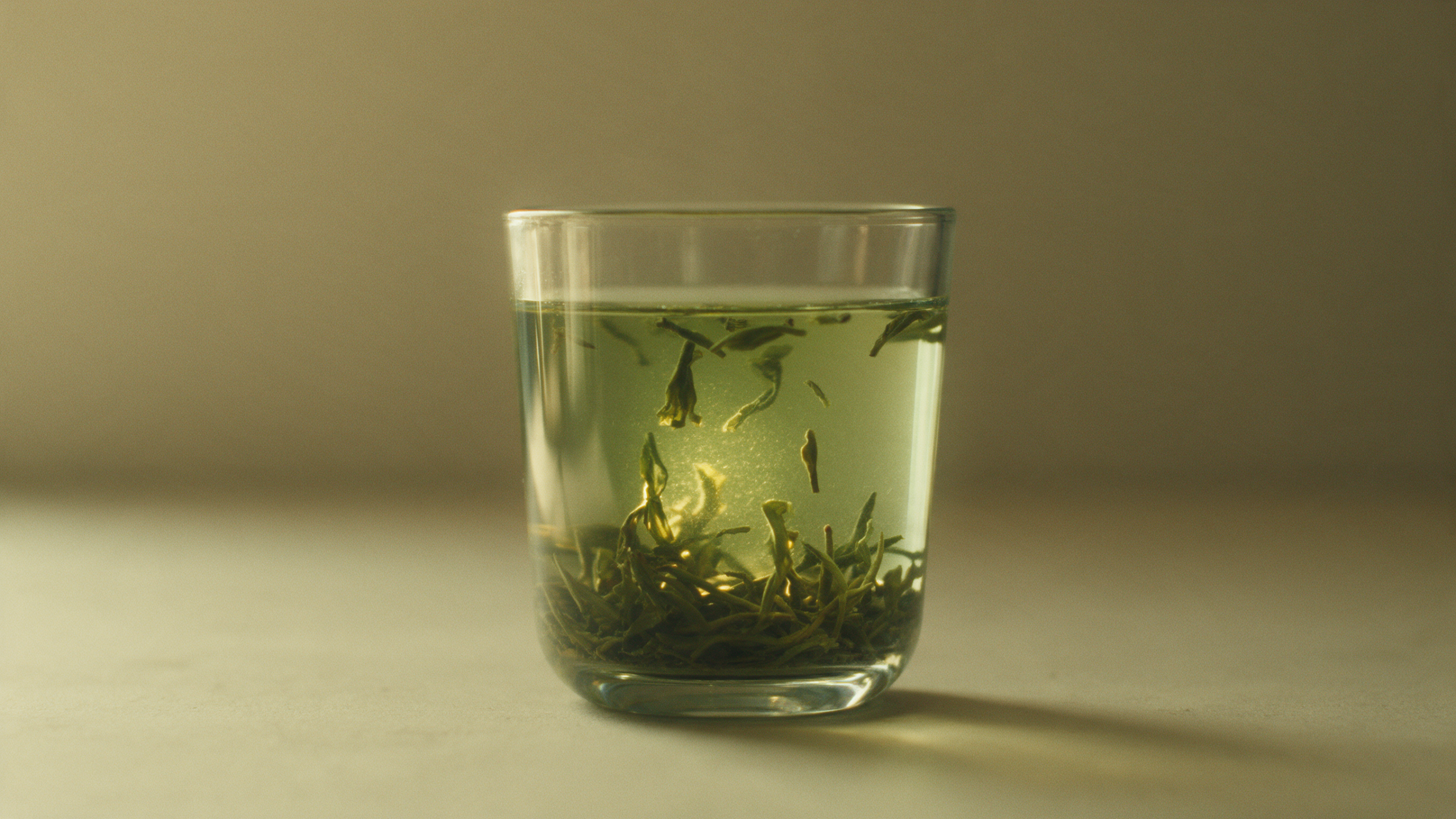
Longjing is not a tea for boiling water. Use about three grams of leaf in a tall glass of around 200 millilitres, at 80 to 85 °C, with no rinse. Pour down the side of the glass so the water slides in rather than striking the leaf. The leaves sink, then rise, and often stand upright in the water — the “tea dance” a true West Lake leaf is known for. Steep a minute, then a little less, for two or three infusions. The traditional everyday method is simply grandpa style: leaf in the glass, water on top, drink as it settles. The formal tea ceremony many visitors expect is a much newer habit, and a different way to drink the same leaf. Boiling water scalds the young leaf and turns it bitter.
Why it tastes of early spring
What reaches the tongue is the chemistry of a young, cool-grown bud. West Lake Longjing is associated with high amino acids and lower polyphenols, which is why it drinks sweet and round rather than bitter: chestnut and a green, mung-bean freshness, a clean mineral finish, and almost no astringency. The colour is the tell of the season — a pale jade-green for the earliest leaf, drifting yellower as the harvest moves past Qingming.
The price follows the same logic. The window is days, a skilled maker can produce only a kilogram or two a day, a picker gathers perhaps a pound in a morning, and the finest grade needs each bud and leaf handled by hand. Small supply against large demand does the rest. The film’s whole subject — a few days of early spring, held in a leaf — is also the reason the tea is dear.
The emperor, the well, and the eighteen bushes
The famous story belongs to the Qing emperor Qianlong. Travelling in disguise by West Lake, he is said to have picked tea by the Hu Gong Temple beneath Lion Peak, then been called back to Beijing because his mother was ill. He had pushed the leaves into his sleeve; the scent lingered, his mother asked for it, drank it, and recovered. Grateful, he is said to have granted imperial status to the eighteen tea bushes in front of the temple. Those bushes still stand, and their tea is auctioned for more per gram than gold.
That is a legend, and it should be read as one. What the records support is narrower. Longjing was granted tribute-tea, gòngchá, status in the Qing; and the eighteen bushes at Lion Peak are traditionally said to have been planted by the Song monk Biancai (辯才法師) in the eleventh century, which is why later writers remember him as an ancestor of the tea. So the grove is old and real; the emperor’s blessing is the story wrapped around it. The garden remains, kept today as the Longjing Imperial Tea Garden. The tea, and the well, came first.
Frequently asked questions
Why is it called Dragon Well?
Dragon Well is a rendering of 龍井 lóngjǐng, the name of the village and the well beside it. The old story is that the well holds a dragon: after rain, the lighter rainwater floating on the denser well water is said to form a twisting line that moves like a dragon’s body. The tea took the well’s name.
What does mingqian mean?
明前 míngqián means “before Qingming”, the festival that falls around 5 April. It is the first flush of the year, picked while the air is still between 10 and 20 °C, and it is the most valuable Longjing. The window that follows it runs on to Grain Rain in mid-April and is called 雨前 yǔqián.
Is Longjing a green tea?
Yes. Longjing is a pan-roasted green tea: the leaf is heated in an iron wok soon after picking to stop it oxidising, and that step is what keeps it green. A leaf that is allowed to oxidise instead becomes one of the other five kinds of tea.
Why is it pan-fired by hand?
Because the hand is what makes the shape. In a wok heated above 200 °C, and without gloves, the maker presses and turns the leaf until it flattens into a blade. The national standard names ten hand movements for the work, and no machine reproduces the result exactly.
What water temperature should I use?
80 to 85 °C, not boiling. Use about three grams of leaf in a tall glass of around 200 millilitres, with no rinse, and pour down the side of the glass so the water slides in rather than striking the leaf. Boiling water scalds the young leaf and turns it bitter.
Is West Lake Longjing different from other Longjing?
Yes. “Longjing” is a protected name under the national standard GB/T 18650, and the protected area covers three zones: West Lake, Qiantang and Yuezhou. Only leaf grown in the smallest of them, the West Lake zone, may be sold as West Lake Longjing, 西湖龍井. Leaf grown elsewhere can still be Longjing-style and fired the same way, and much of it is.
The film, in words
Every caption card that appears on screen in the film, in order. The film has no narration – this is its full text, so it can be read and quoted.
Read the full text – 68 caption cards
- Before Qingming, only the youngest tender buds are plucked from West Lake hills.
- This is Dragon Well – green tea at its earliest.
- The hills around West Lake hold their mist a little longer each morning.
- Before Qingming, the buds are still small and tight.
- So why does a whole year wait for these few days?
- Only the youngest, most tender tips are chosen.
- A plucker moves bud by bud, without hurry.
- Pick too late, and the leaf hardens into something ordinary.
- Each spring, the hills are picked for only a few days.
- Each bud still carries the cold of the night before.
- This is what early spring tastes like.
- But the leaf will never be this soft again.
- The greenest buds are chosen for a flat, straight shape.
- Dragon Well comes from the hills of Hangzhou, by West Lake.
- Nothing is added to them – only time, and hands.
- By midday, the baskets are barely full.
- From the hill, the buds travel toward the wok.
- The newly picked buds are as green as jade.
- Then the buds meet the iron wok.
- The wok is held at 200°C.
- A hand presses the leaves against the hot metal.
- This step is called pan-firing, and it stops the leaf from oxidizing.
- The heat fixes the leaf before it can turn brown.
- So why must it be done by hand?
- Because only a hand can feel the right moment.
- The heat fixes the green, and the leaf begins to flatten.
- Press, lift, press again – the shape is made by hand.
- The press of a hand gives the leaf its shape.
- The leaf comes out flat and straight, like a small blade.
- In those minutes, a roasted chestnut aroma rises.
- That scent is locked into the leaf, and kept for the cup.
- Too little heat, and the leaf stays raw.
- In the Qing, this tea was named a tribute.
- Too much heat, and the delicate notes burn away.
- A whole day's picking becomes only a little tea.
- And so the green is sealed inside the blade.
- Now the tea is ready, but the water is not.
- For Dragon Well, choose glass or white porcelain.
- A clear vessel lets you watch the leaves.
- Boiling water would be too rough for this leaf.
- Green tea asks for the least intervention.
- Let it cool until it drops to around 80°C.
- The target is 80°C to 85°C.
- So why is cooler water better here?
- Because at that heat, the delicate amino acids are spared.
- Pour slowly, and do not hit the leaves directly.
- Water along the wall of the glass is gentler.
- Give it a moment, and the green wakes again.
- Cooler water is not weaker – it is more careful.
- The first pour is the brightest.
- Every later pour fades a little.
- This is a tea that asks to be watched.
- Now watch the cup.
- The buds rise, then sink, then rise again.
- They dance up and down, standing on end.
- So why do the leaves stand upright?
- Because the flat blade floats and turns in the water.
- Some hang near the surface. Others settle at the bottom.
- The water slowly turns a pale, clear green.
- Nothing here was rushed.
- This rising and sinking has its own name: the tea dance.
- The hills, the buds, the wok, the cooling water – all of it.
- Early spring is not a season. It is a few days.
- And here it sits, in one clear cup.
- Drink while it is warm.
- The taste is fresh, green, and light.
- It ends long before you want it to.
- So the whole year waits again.
Sources
- UNESCO Intangible Cultural Heritage, Traditional tea processing techniques and associated social practices in China (No. 01884, inscribed 2022)
- GB/T 18650-2008, 《地理标志产品 龙井茶》 (Product of geographical indication — Longjing tea), National Standards of China
- Hangzhou Municipal Government, Tea Culture of Hangzhou (2021)
- Hangzhou Municipal Government, 首个龙井茶国家标准样品在杭州发布 (2024)
- West Lake Longjing Tea Management Association, 数说春天里的那一片绿叶 (每日商报, 2024)
- 西湖龙井茶产品标准发展历程及现状调查分析, 中国茶叶加工, 2023 (1)
- Hangzhou, Where Tradition Meets Innovation, Longjing Imperial Tea Garden
- china.org.cn, Longjing’s Cup Overflows
- Wikipedia / Encyclopaedia Britannica, Longjing tea
- Serious Eats, Dragon Well (Longjing) Tea
This piece accompanies the film Dragon Well Green Tea: The Taste of Early Spring, Episode 3 of Objects of China — the art of Chinese tea.
Written and published by Eastern Whispers – how this site researches, and how it discloses its sources