
There was never only one Silk Road. By about 50 BC ships could sail down the Red Sea and use the monsoon winds to cross the Arabian Sea and reach the ports of the west coast of India – a sea route running in parallel with the caravan tracks, and eventually taking their business.[1]
Why the monsoon mattered more than the map
An overland caravan carries what an animal can carry, and pays tolls at every border. A ship carries the contents of a village and, if the wind is right, crosses an ocean on schedule. The monsoon is seasonal and predictable: once sailors understood its timing, the Indian Ocean became a highway with a timetable.[1]
Where the two systems met
The two networks touched at the ports and at the river routes inland. Trade goods came up the Indus to Gandhara and on toward China through the passes; the same goods could leave Alexandria or the Red Sea ports by water. Monks travelled both – Buddhism spread across Asia through overland and maritime networks alike, and its transmission followed the development of the routes as channels for exchange.[1][2]
What the sea did to the land
It slowly replaced it. As shipping routes supplanted the overland tracks, the land route lost its traffic – and the settlements along it, including the cave temples at Mogao, lost the income and the attention that had kept them alive.[3]
The lesson of the two roads
Goods do not care whether they move on a camel or a hull, and they take the cheaper way. The history of the Silk Road is not really a history of roads at all: it is a history of which route was cheapest at the time, and of everything that grew up beside the winner.[1][3]
This piece accompanies the film Ports of the Sea.
Read next: how goods moved on land, and is any of it still there today The film that goes with this piece is Ports of the Sea.
Chinese words in this piece
- 海路 hǎilù — the sea route
- 季風 jìfēng — monsoon – the seasonal wind the route depends on
- 港口 gǎngkǒu — port, harbour
- 船 chuán — ship, boat
Questions
What was the Maritime Silk Road?
The sea route linking the Red Sea, the Arabian Sea and the ports of India and China – used in parallel with the overland caravan routes, and eventually more important than them.
Why were the monsoon winds so important?
They are seasonal and predictable. Once sailors could time them, the Indian Ocean became a regular, scheduled route rather than a gamble.
Did the sea route end the overland trade?
Gradually, yes. As shipping supplanted the overland tracks, the land route lost its traffic, and the towns and cave temples along it lost the income that had sustained them.
The film, in words
Every caption card that appears on screen in the film, in order. The film has no narration – this is its full text, so it can be read and quoted.
Read the full text – 48 caption cards
- A container ship approaches the Malacca Strait at night.
- Two hundred metres of steel move almost without sound.
- The bridge is dark except for its instruments.
- Lights of other ships pass like a slow city.
- The pilot boat comes alongside and a ladder drops.
- A local pilot steps aboard and takes the conn.
- He knows this channel the way a farmer knows a field.
- The ship is longer than the street you grew up on.
- Below the waterline, thirty thousand boxes ride quietly.
- At Piraeus, gantry cranes stand along the quay.
- Nobody unloads with baskets and shoulders any more.
- A crane lifts forty tonnes and sets it down in minutes.
- The quay is measured in hours now, not weeks.
- Trucks queue under the gantries like a moving wall.
- Colombo, Gwadar, Djibouti: names on the same schedule.
- Ports are places where time is counted as money.
- Every crane is a small machine for shortening a journey.
- By morning the deck is empty and the ship sits higher.
- On the deck the crew check the lashings again.
- Ropes thick as an arm hold the containers down.
- Salt has dried white on every rail and turnbuckle.
- A bosun tightens a twistlock with a steel bar.
- The wind at night is cold and tastes of metal.
- A bridge watch logs the course every four hours.
- In the mess, rice cooks and the kettle will not stop.
- A photograph of a family is pinned by the door.
- Somebody's daughter has grown since the last port.
- The sea keeps a rhythm the ship cannot argue with.
- At four in the morning, only the radar turns.
- A cup is wedged in a holder so it will not spill.
- The wake behind them is a long white line.
- Eight months aboard the ship, then home for two.
- He knows every horn and every running light.
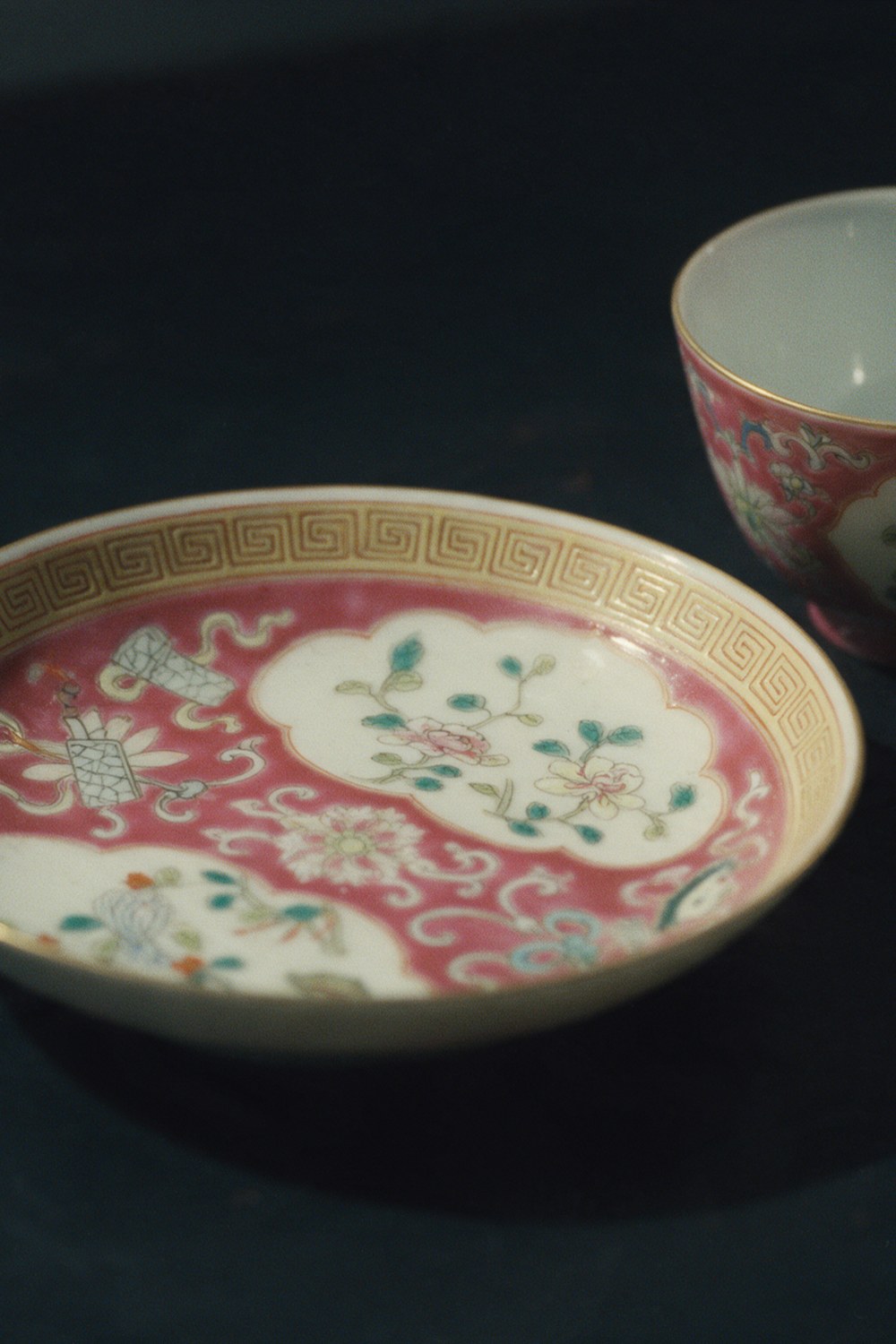
- Porcelain once left Jingdezhen by river, then by sea.
- Junks carried it to Malacca, Ceylon, and East Africa.
- Spices, ivory and glass came back the same way.
- A voyage then could take a year, or never finish.
- Today the same chain of ports still carries the trade.
- Shanghai, Singapore, Piraeus, Rotterdam, and then back again.
- A container ship holds more than twenty thousand boxes.
- Every box is checked by number at every port.
- The road is not one sea but a chain of harbours.
- Weeks later, a container is opened in another hemisphere.
- Inside: tea tins, porcelain bowls, and paper lanterns.
- A shopkeeper lifts one bowl and turns it to the light.
- The glaze is the same colour it was four hundred years ago.
- She does not know the port where the journey started.
- But the sea that carried it is the same sea.
Twelve free pages on the objects of China – and ten Chinese words from the films – are in The Art of Chinese Tea: A First Look.
Sources
- [1] Buddhism along the Silk Road – The Metropolitan Museum of Art
- [2] Buddhism on the Silk Routes – University of Washington, Silk Road Project
- [3] The Conservation of Cave 85 at the Mogao Grottoes, Dunhuang – Getty Conservation Institute
The films and the music are AI-assisted and then chosen, written and cut by hand. Every claim above is drawn from the sources listed; anything we could not confirm has been left out.
Written and published by Eastern Whispers — how this site researches, and how it discloses its sources