
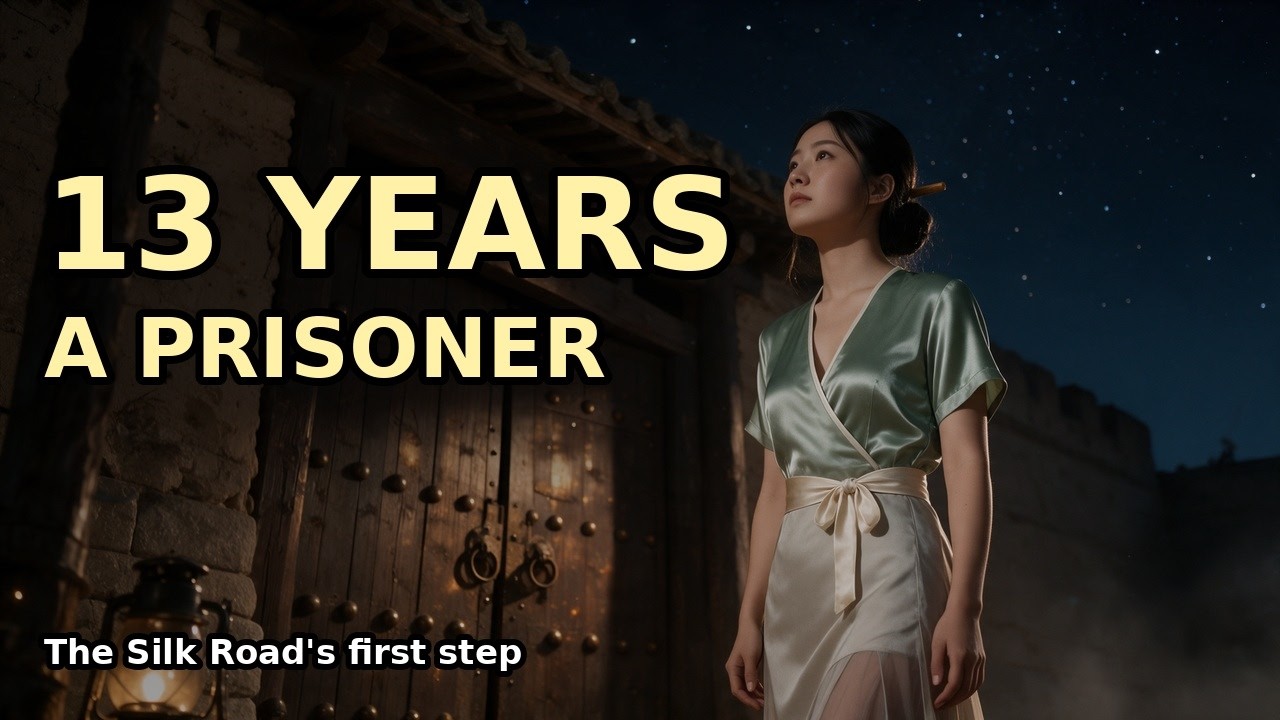
In 138 BC the Han court sent one officer west to find an ally against the Xiongnu. He did not get the alliance. He came home thirteen years later with the first reliable account of Central Asia that any Chinese court had heard – and the road that later generations called the Silk Road (絲綢之路 sīchóu zhī lù) followed the line he described.[1]
Who Zhang Qian was
Zhang Qian(張騫 Zhāng Qiān) was dispatched by the Han emperor Wudi in 138 BC to make contact with the Yuezhi, a Central Asian people who spoke an Indo-European language. He was captured by the Xiongnu, the nomadic power that dominated the steppe, and was detained for ten years. He nevertheless reached his destination and returned to China after an absence of thirteen years.[1]
What his report contained
The mission failed diplomatically – the Yuezhi had no interest in a war with the Xiongnu. What Zhang Qian brought back instead was knowledge. He had travelled himself and had sent assistants further, to the Fergana Valley, Bactria and Sogdiana, gathering information on Parthia, India and the states in between. His account brought the Chinese into contact with the outposts of Hellenistic culture, opened the way for exchanges of envoys, and led to the introduction into China of a superior breed of horses and of new plants such as grapes and alfalfa.[1]
The line he described
Seen from UNESCO’s point of view, the road begins at Chang’an(長安 Cháng’ān), the capital of the Han and Tang dynasties, and runs west across the Hexi corridor to the Yumen Pass at Dunhuang – the corridor that was inscribed as a World Heritage site in 2014.[2] Zhang Qian’s route west is the earliest stretch of that corridor to be described by a Chinese traveller who had actually walked it.
Did he reach Rome?
No. He reached Central Asia, and he sent others further than he went himself, but the Roman world was beyond both his travels and his information: what he reported was Parthia and the lands around it, and the goods that travelled between the two ends of the route did so through many hands.[1]
What came back east
The clearest result of the mission was material. His report led to the introduction into China of a superior breed of horses and of new plants, among them grapes and alfalfa – the fodder crop that would help keep those horses alive.{c1} What went the other way was slower to show itself: envoys, and with them the habit of asking what lay west.
Watch the film
This piece accompanies the film The First Step West.
Read next: the last Chinese post before the desert, and how goods actually moved along the route. The full route is set out on the Prelude: The Silk Road page.
Chinese words in this piece
- 張騫 Zhāng Qiān — Zhang Qian, the Han envoy sent west in 138 BC
- 絲綢之路 sīchóu zhī lù — the Silk Road, a name for a route that was never one road
- 長安 Cháng’ān — Chang’an, the Han and Tang capital, today’s Xi’an
- 大宛 Dàyuān — Dayuan, the Fergana Valley, where the best horses came from
Questions
Did Zhang Qian reach Rome?
No. He reached Central Asia and sent assistants to the Fergana Valley, Bactria and Sogdiana, and reported on Parthia and India – the Roman world lay beyond his travels and his information.
How long was Zhang Qian away?
Thirteen years. He left in 138 BC and returned to China after an absence of thirteen years, having been detained by the Xiongnu for ten of them.
What did his mission achieve?
Not the alliance he was sent for, but knowledge: the first reliable Chinese account of Central Asia, which opened exchanges of envoys and brought new horses and plants into China.
The film, in words
Every caption card that appears on screen in the film, in order. The film has no narration – this is its full text, so it can be read and quoted.
Read the full text – 48 caption cards
- Before there was a road, there was a single question: what lies west?
- In 138 BC the Han court sent one man to find out.
- Zhang Qian left Chang'an with a staff of office and no map.
- The last gate closed behind him, and the plain went on forever.
- Beyond it the road narrowed to a corridor of dust.
- Mountain on one side, desert on the other, sky pressing down.
- Water was measured; every step was counted.
- His journey ended abruptly — horsemen of the Xiongnu took him.
- A stranger was kept, but not silenced.
- Ten years among people whose words he did not know.
- He learned their speech in the winter camps.
- He learned their horses, the fastest he had ever seen.
- He learned their grass, and why their herds were strong.
- Each year he tied a knot in a leather cord.
- The staff of office stayed hidden, but never lost.
- In the quiet he built a map inside his head.
- Rivers, passes, pastures, and the names of distant kingdoms.
- Then one day the guard was thin, and he walked out.
- He did not turn back east. He went on west.
- He reached Dayuan, where the horses ran like wind.
- He saw grapes growing in rows, and alfalfa in green fields.
- He heard of lands further still — Bactria, Parthia, and beyond.
- A world wider than anyone at home had imagined.
- Thirteen years after leaving, he turned for home.
- He came back with seeds, and with stories.
- Grape vines. Alfalfa. And a report the court had never heard.
- His journey had failed at every step, and changed everything.
- Because of him, merchants knew where the water was.
- Caravans followed the line one man had walked alone.
- Silk went west; horses, glass and ideas came east.
- Faiths travelled too — quietly, one monastery at a time.
- Nothing about it was planned. It simply connected.
- The road was never one road. It was many footprints.
- Sand, snow, stone, and always another horizon.
- A camel's tired pace is the oldest rhythm of trade.
- Bells at dusk told travellers a camp was near.
- In the morning, a gate, a market, a language you did not know.
- Centuries later, the road is still being walked.
- Its caravans are trains now, running on steel.
- Its harbours are cranes and containers and lights.
- But the impulse is the same: to go and see what is there.
- One man walked west, and the world got smaller.
- The road he opened is still open.
- Every traveller since has walked in his footprints.
- Trade, faith, food, music: all of it moved along this line.
- What travels fastest is not goods, but curiosity.
- In 138 BC, one step west was enough.
- The rest of the road was built by everyone who followed.
Twelve free pages on the objects of China – and ten Chinese words from the films – are in The Art of Chinese Tea: A First Look.
Sources
- [1] Zhang Qian – Encyclopaedia Britannica
- [2] Silk Roads: the Routes Network of Chang’an-Tianshan Corridor – UNESCO World Heritage
The films and the music are AI-assisted and then chosen, written and cut by hand. Every claim above is drawn from the sources listed; anything we could not confirm has been left out.
Written and published by Eastern Whispers — how this site researches, and how it discloses its sources