
Silk is animal fibre. It is produced by the caterpillar of the domesticated silkworm moth, Bombyx mori, which is raised on mulberry leaves – the process called sericulture(養蠶 yǎngcán).[1][2]
The worm and the leaf
Sericulture is two processes running together: keeping the worms alive from egg to cocoon, and growing enough mulberry trees to feed them. The caterpillars eat mulberry leaf through the larval stage; the quality of the leaf decides the quality of the silk.[2]
One unbroken thread
When the caterpillar is ready, it spins. Liquid secretion from two large glands in its head comes out through a single tube, the spinneret, and hardens on contact with air into twin filaments of fibroin – a protein – which a second pair of glands cements together with sericin, a gum. The result is the cocoon, and the roughly one kilometre of continuous thread wound into it.[1][2]
Why the moth is not allowed out
This is the part people find hardest. An emerging moth would break the single filament that the cocoon is made of, so the silkworm is killed in the cocoon with steam or hot air, at the chrysalis stage. Enough moths are kept back to lay the next year’s eggs. The thread is then reeled off, spun and woven.[2]
How the secret travelled
Weaving silk became a major industry and one of China’s chief exports under the Han dynasty, and the caravan route across Central Asia – the Silk Road – carried it to Syria and on toward Rome.[1] The knowledge took far longer to leave. According to the account recorded in the west, the Byzantine emperor Justinian persuaded two Persian monks who had lived in China to bring silkworm eggs back to Constantinople hidden in the hollow of a bamboo cane, around 550 AD – the beginning of European sericulture.[1]
Six centuries to leave home
The cloth travelled much faster than the knowledge. Britannica records sericulture spreading overland from China to India about 140 BC – and the art being lost in the west and reintroduced from China in the sixth century AD.[1] For roughly six hundred years, everyone could buy the silk; almost nobody outside China could make it.
Watch the film
This piece accompanies the film The Fabric Worth an Empire.
Read next: how goods actually moved along the route, and which Chinese inventions travelled with it The film that goes with this piece is The Fabric Worth an Empire.
Chinese words in this piece
- 絲 sī — silk
- 養蠶 yǎngcán — sericulture, the raising of silkworms
- 蠶 cán — the silkworm
- 桑 sāng — mulberry – the tree whose leaves the worms eat
Questions
What is silk made from?
The cocoon of the domesticated silkworm moth, Bombyx mori, which is fed on mulberry leaves.
How long is one silk thread?
Roughly one kilometre of continuous filament per cocoon, which is reeled off, spun and woven.
How did silk reach Europe?
As cloth along the caravan routes from the Han dynasty onward. Silkworm eggs reached Constantinople around 550 AD, according to the traditional account of two monks and a bamboo cane.
The film, in words
Every caption card that appears on screen in the film, in order. The film has no narration – this is its full text, so it can be read and quoted.
Read the full text – 48 caption cards
- In spring the mulberry leaves are picked before the sun is up.
- A grove of low trees feeds the most valuable animal in China.
- Silkworms eat for days and stop only to sleep.
- Then they wrap themselves in one long continuous thread.
- At dawn the reeling bowls are filled with warm water.
- A cocoon is softened, and the end of the filament found.
- It comes out wet, very fine, and impossibly strong.
- A single cocoon holds hundreds of metres of one thread.
- Nothing else in the ancient world was made like this.
- The loom house is quiet except for the treadles.
- A warp of silk threads waits stretched and perfectly level.
- Two threads cross, a thousand times every hour.
- The weaver leans in and counts without counting.
- The pattern lives in the loom's own memory, thread by thread.
- Gauze, damask and brocade: one thread, different gifts.
- One bolt of silk can take a woman a whole season.
- Her eyes are the most expensive tool in the room.
- Finished silk is rolled, tied and set aside with care.
- By lamplight the silk thread looks almost like water.
- Held to a lamp, one thread glows like a hair of light.
- In the south the worms breed twice, sometimes three times.
- A second crop in summer means another reeling season.
- The work is warm and repetitive and cannot be hurried.
- One broken filament spoils the whole length of thread.
- So the hands move slowly, and the breathing goes still.
- Every skein carries the hours of whoever wound it.
- Patience here is not a virtue. It is a technique.
- Weight for weight, this thread was worth more than gold.
- A single robe could cost a small farm, or a life.
- It was light enough to pass through a finger ring.
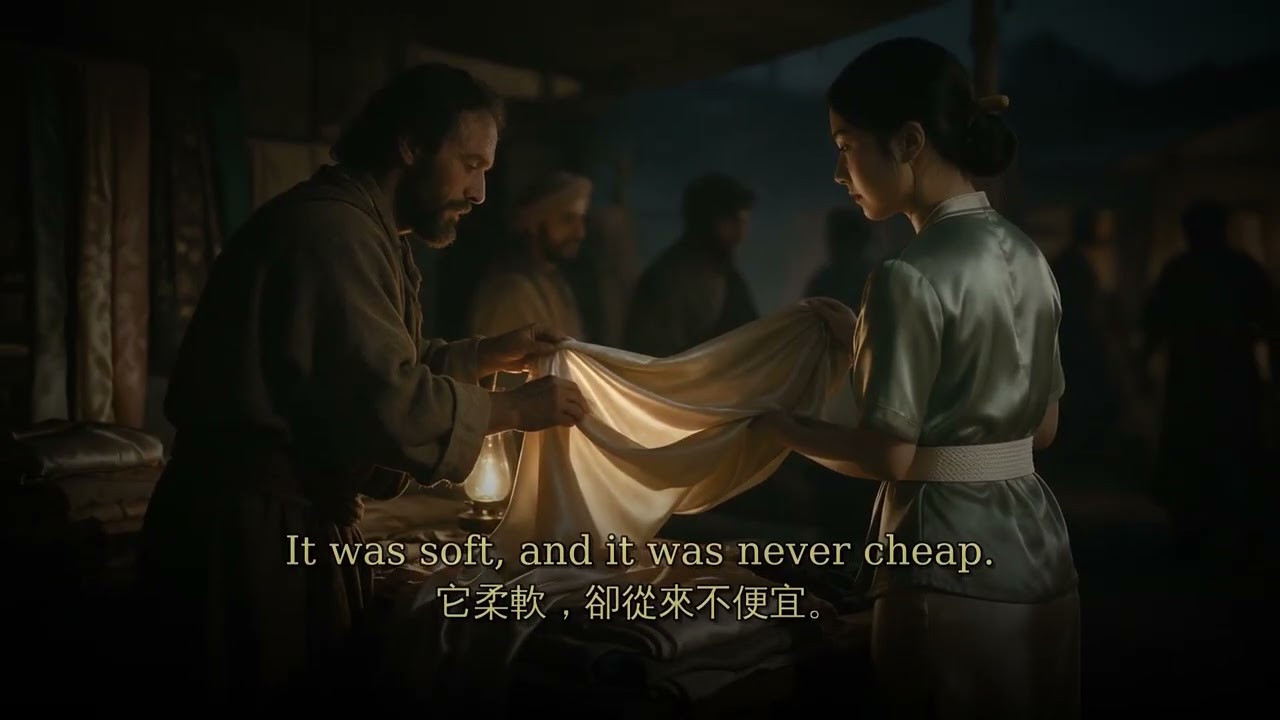
- It was soft, and it was never cheap.
- A long road only made it more expensive.
- The West wanted it, and had no idea how to make it.
- It left in bales, roped onto camels, tied tight.
- It crossed deserts where even water was a toll.
- It passed through many hands, and each hand added a price.
- In Rome it was sold lighter than anyone could believe.
- Senators were told to stop wearing it. They did not.
- Its making was a state secret for a very long time.
- Silk travelled as a gift before it travelled as a good.
- Kings gave it away to buy peace, not money.
- Wherever it was given, a road was kept open.
- In the south of China the worm still eats mulberry.
- The loom still stands in workshops that smell of oil.
- Now silk is sold by the metre, in shops and online.
- A fabric that needed an empire still needs human hands.
- Nothing synthetic has ever quite managed to replace it.
- Five thousand years on, silk is still woven in China.
Twelve free pages on the objects of China – and ten Chinese words from the films – are in The Art of Chinese Tea: A First Look.
Sources
The films and the music are AI-assisted and then chosen, written and cut by hand. Every claim above is drawn from the sources listed; anything we could not confirm has been left out.
Written and published by Eastern Whispers — how this site researches, and how it discloses its sources